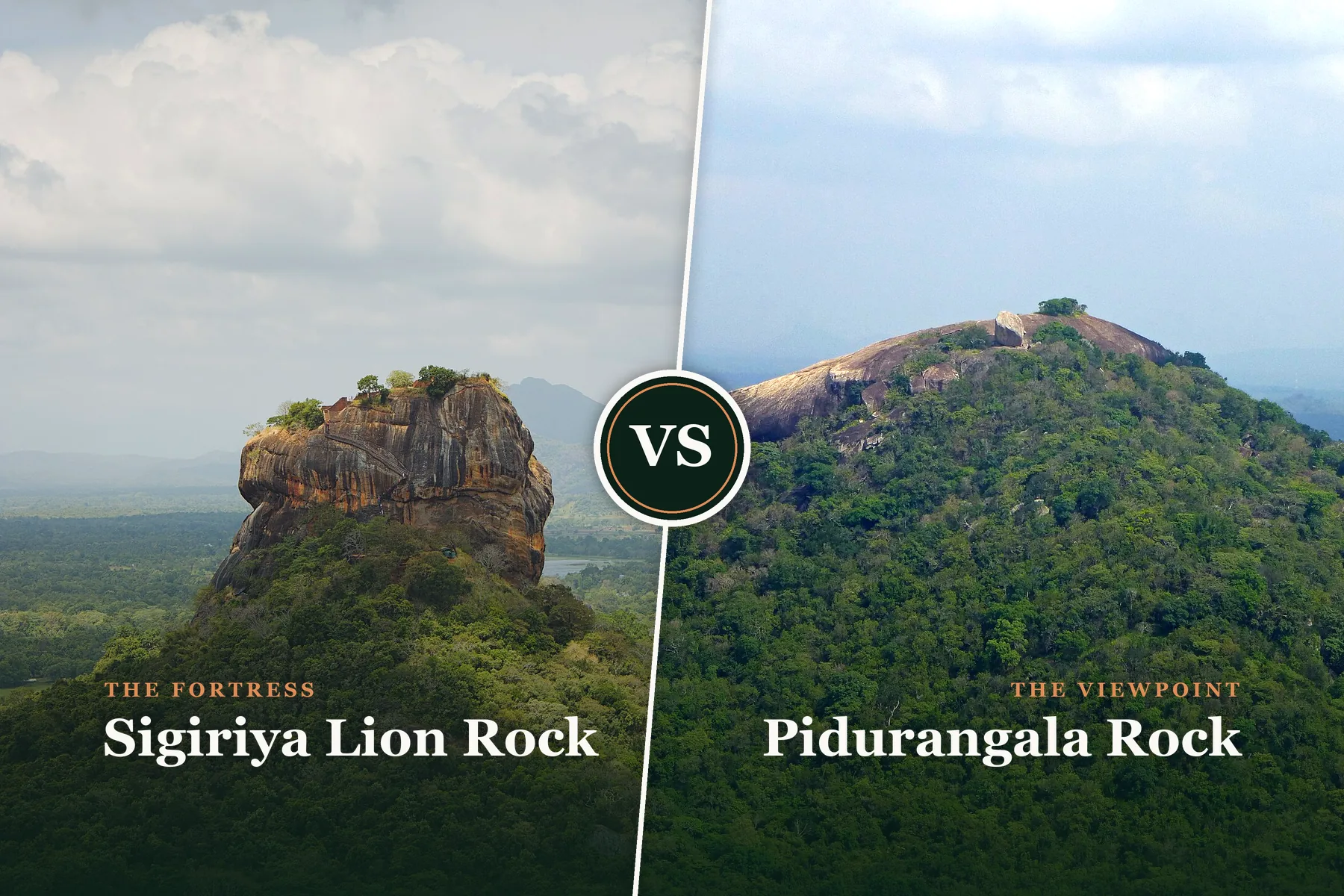
Two granite rocks stand a kilometre apart in the middle of Sri Lanka, and nearly everyone who travels to them ends up asking the same question: Sigiriya Lion Rock vs Pidurangala climb - which one deserves the morning? Sigiriya is the famous one, a fifth-century royal citadel with the most expensive ticket in the country. Pidurangala is the rock next door, a monastery hill that costs about $3 to climb and has the best view of Sigiriya there is.
Sigiriya Lion Rock vs Pidurangala climb at a glance
| Sigiriya Lion Rock | Pidurangala Rock | |
|---|---|---|
| What it is | Fifth-century palace and fortress; UNESCO World Heritage Site since 1982 | Ancient Buddhist monastery, with a working temple at its foot |
| Foreign adult ticket | US$35, charged in rupees | About 1,000 rupees (roughly US$3), cash only |
| Run by | Central Cultural Fund (government) | The temple |
| Opening hours | Officially 7am to 5pm | Ticket desk from about 5am to about 6pm |
| The route | About 1,200 steps: stone stairs, then metal staircases with handrails | Stone steps through forest, then a boulder scramble with no handrails |
| Time to the top | 45 to 60 minutes | 30 to 45 minutes |
| Whole visit | 2 to 3 hours | 1.5 to 2 hours |
| Hardest part | The exposed final staircase above the Lion Terrace | The last 10 to 15 minutes, over and between boulders |
| The view | 360 degrees over the gardens, reservoirs and jungle | Sigiriya itself, face-on across the forest |
| Crowds | Busy from about 9:30am, with queues on the staircases | Quiet by day; busy on the summit at sunrise and sunset |
| Dress code | None | Shoulders and knees covered through the temple |
| Best for | History, archaeology and first-time visitors | Sunrise, photographs and tight budgets |
Fees and hours were checked in November 2026. Sigiriya is run by the government's Central Cultural Fund, which publishes the opening hours and ticket rules; the foreign adult rate has been $35 throughout 2026. Pidurangala's fee is set by the temple and is not published anywhere official, so take 1,000 rupees as what visitors were being charged this year, and carry a little more.
What you are actually climbing
The two rocks are geological twins. Both are inselbergs - isolated towers of hard igneous rock, probably the plugs of long-vanished volcanoes, left standing as the land around them wore away. NASA's Earth Observatory has photographed the pair from orbit and puts Sigiriya's cliffs at up to 180 metres above the surrounding forest; Pidurangala sits about a kilometre to the north.
Their histories divide in the fifth century. King Kashyapa - also written Kasyapa or Kassapa - ruled from 477 to 495 CE, having taken the throne from his father, and built his capital on and around Sigiriya: moats and water gardens at the foot, a gallery of frescoes on the western face, a gatehouse in the form of a giant lion halfway up, and a palace on the summit. UNESCO added the Ancient City of Sigiriya to the World Heritage List in 1982. After Kashyapa's death the rock went back to the monks, who stayed until about the fourteenth century.
Pidurangala is the other half of the same story. Monks had lived in its caves for centuries before Kashyapa, and the chronicles say that when he claimed Sigiriya he moved the monks who meditated there to Pidurangala Vihara and enlarged that monastery in return. That is why one rock carries a palace and the other has a working temple at its foot, cave shelters with early inscriptions, and a large brick reclining Buddha under an overhang on the way up.
The climb: which rock is harder?
They are hard in different ways. Sigiriya is longer, hotter and harder on the nerves; Pidurangala is shorter and rougher underfoot.
Sigiriya Lion Rock: 1,200 steps and a head for heights
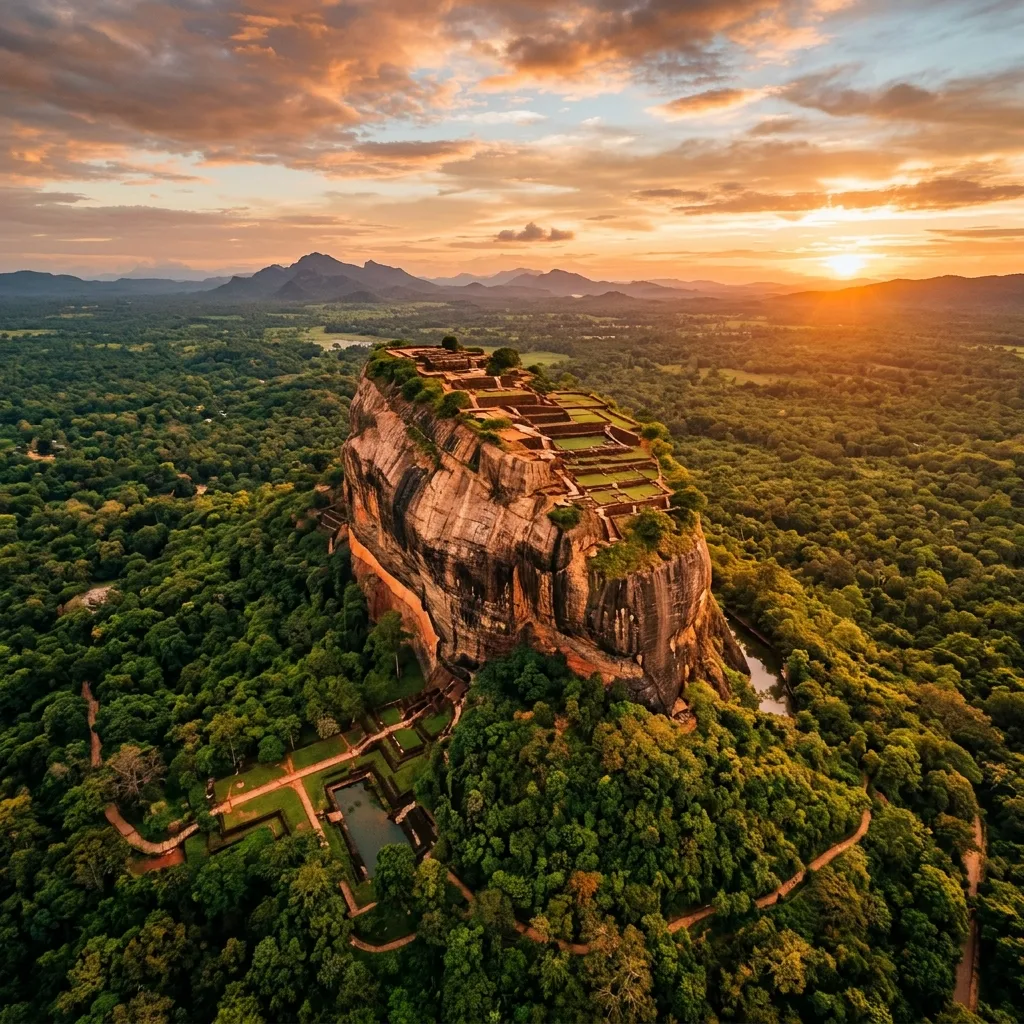
The route is a built staircase from bottom to top, about 1,200 steps in all. It starts on the flat through the water gardens, climbs shaded stone stairs through the boulder gardens, then takes a spiral staircase up to the fresco gallery and runs along the mirror wall to the Lion Terrace - a broad platform where two enormous paws flank the last flight. From there a metal stairway bolted to the open rock face leads to the summit. Nothing on the climb needs your hands and there are handrails all the way, but that final section is steep, exposed and single-file, and it is the part people with a fear of heights remember. Allow 45 to 60 minutes to the top at a steady pace and two to three hours for the whole site. Our guide to climbing Sigiriya goes through it stage by stage.
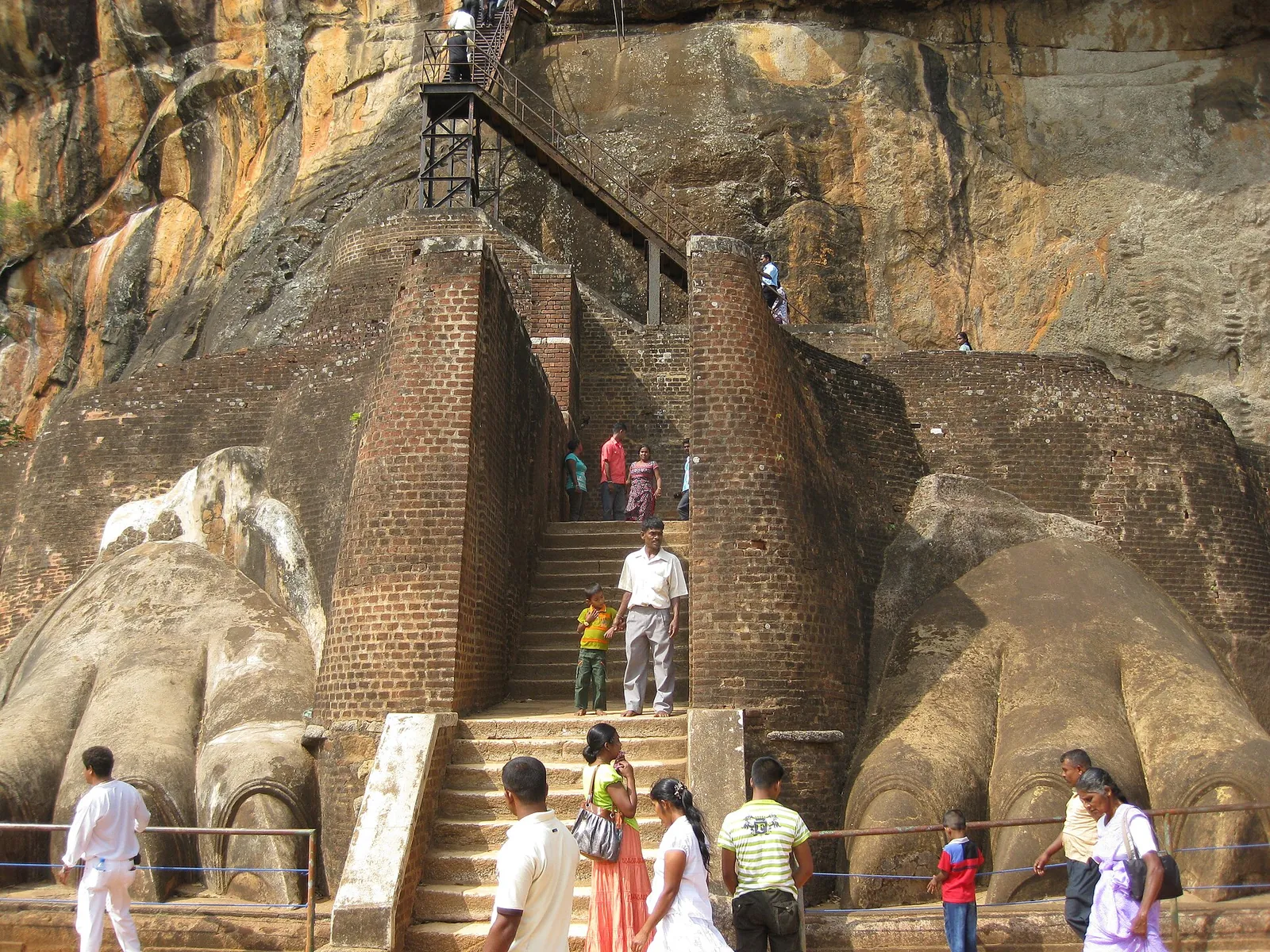
Photo by shankar s. via Wikimedia Commons, licensed under CC BY 2.0.
Pidurangala: a forest path, then a scramble
Pidurangala begins in the temple grounds, where you pay the fee and follow uneven stone steps uphill through forest. After about fifteen minutes the path reaches the reclining Buddha - around twelve metres of brick beneath a rock overhang, its head and upper body rebuilt after treasure hunters destroyed them in the 1960s. Beyond the statue the steps run out. The last ten to fifteen minutes is a scramble over and between large boulders, with a couple of moves that need both hands and one long step up onto the summit slab. There are no handrails, and in the dark the line is not always obvious, so carry a proper torch and watch where the people ahead of you go. Allow 30 to 45 minutes to the top.
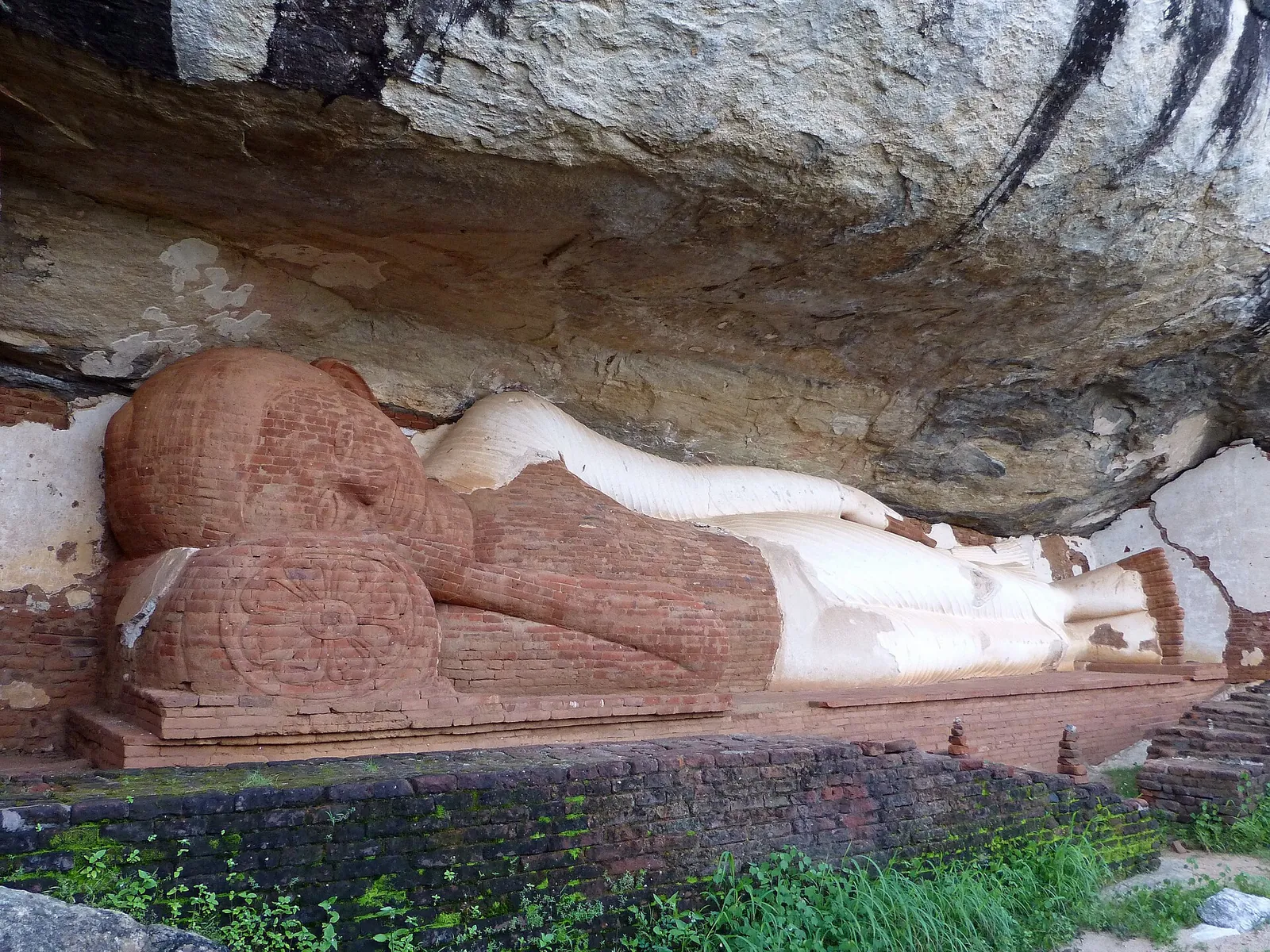
Photo by Ji-Elle via Wikimedia Commons, licensed under CC BY-SA 3.0.
So which is harder? For most people Sigiriya is the more tiring climb and Pidurangala the more awkward one. If stairs and heat are what wear you down, Pidurangala is easier. If balance, knees or confidence on bare rock are the worry, Sigiriya is easier: everything has a step and a rail. Anyone unsure about the scramble can walk as far as the reclining Buddha and decide there, but the open summit and its view are only reached by going over the boulders.
The view from the top
This is where the choice becomes simple. From the summit of Sigiriya you see everything except Sigiriya: the symmetrical gardens laid out far below, reservoirs and forest to the horizon, the hills of the central highlands to the south and Pidurangala's bare dome to the north. You are also standing in what is left of the palace - terraces, foundations and a cistern cut into the rock.
From Pidurangala you see Sigiriya itself, whole, across a kilometre of treetops. It is the angle that makes the Lion Rock look like the fortress it was, and it is why photographers prefer this summit to the famous one. The top is a broad, sloping sheet of granite with room to spread out and no fences, so keep back from the edges - and keep hold of children.
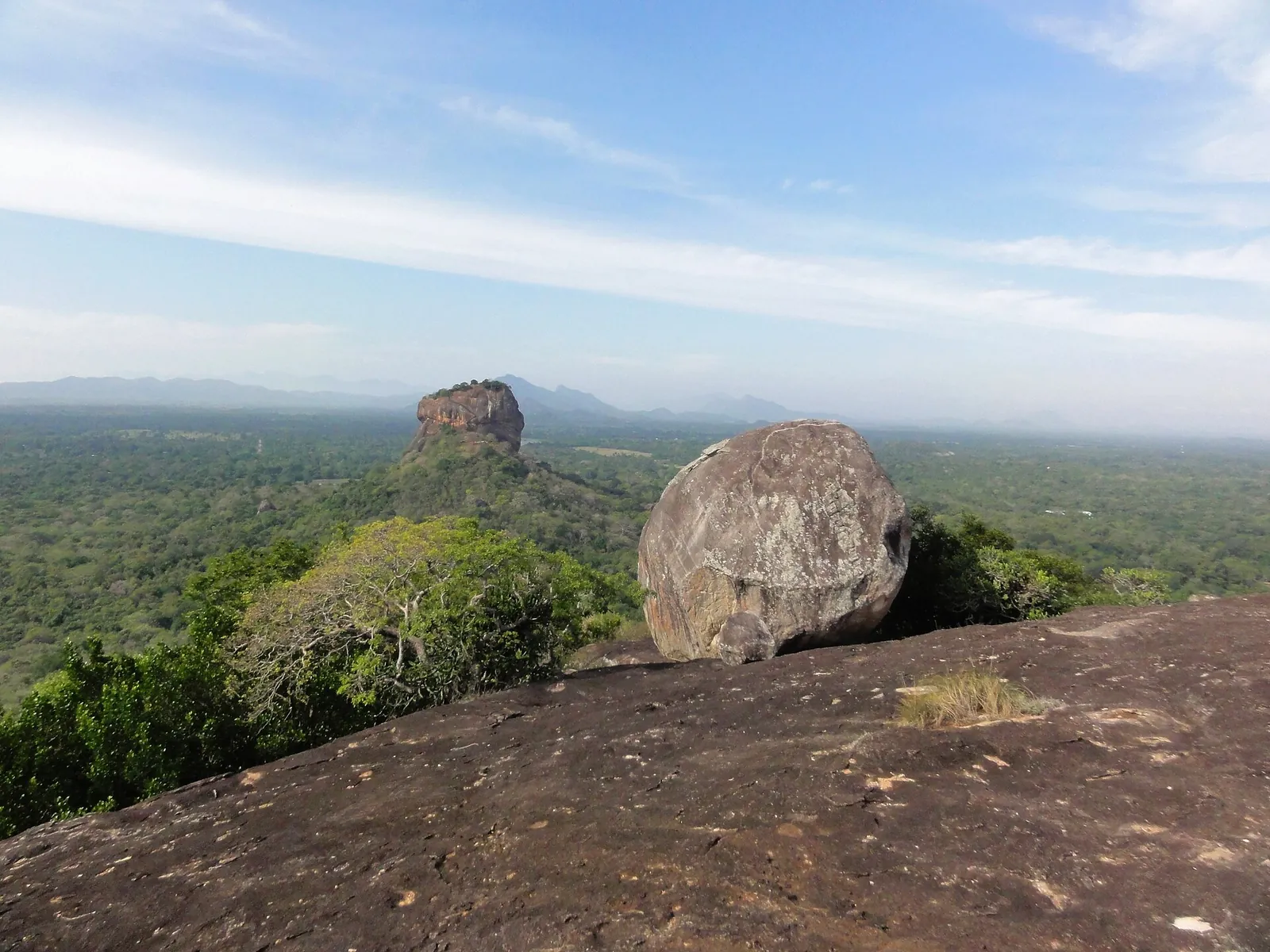
Photo by Westbeachzero via Wikimedia Commons, licensed under CC BY-SA 3.0.
Cost: $35 against about $3
Sigiriya is the most expensive ticket in Sri Lanka. Foreign adults pay US$35, charged in rupees at the day's rate. Holders of SAARC passports pay half on showing the passport, children pay a reduced rate and under-sixes go free. The ticket is good for one entry and includes the Sigiriya Museum near the entrance. Buy it at the ticket office, or in advance through the Central Cultural Fund's e-ticket service, which issues a receipt that you exchange for the ticket at the counter.
Pidurangala belongs to the temple rather than the government, and it charges foreign visitors a flat 1,000 rupees - about $3 - in cash at a desk in the temple grounds. Older guides quote 500 rupees; the fee has since doubled. There is no card machine, so bring small notes.
For two adults that is $70 against roughly $7, which is why Pidurangala is so often sold as the cheap alternative to Sigiriya. That is a fair description of the view and an unfair one of the site: Pidurangala has no frescoes, no gardens and no palace. Our entrance fees guide lists what the other big sights cost, and the money guide covers cash, cards and ATMs.
Sunrise and sunset: which rock, and when
Pidurangala is the sunrise rock. Its ticket desk opens at about 5am, well before first light, and the summit looks south across the forest to Sigiriya as the sun comes up on your left. Sunrise here falls between roughly 5:50 and 6:30am depending on the month, so start walking 45 minutes to an hour before it. You will not be alone - in the December to April season a few dozen people share the summit - but the rock is big enough to absorb them.
Sigiriya does not work for sunrise. The Central Cultural Fund gives its hours as 7am to 5pm, and although the gate has at times opened earlier, the climb takes most of an hour, so the sun is well up before anyone reaches the top. What matters at Sigiriya is being ahead of the heat and of the tour coaches, which arrive from about 9:30am. Be at the ticket office when it opens, or come after 3pm, when the day-trippers have gone and the light turns warm.
At sunset Pidurangala wins again, because Sigiriya's gates close before the sun goes down and because you are watching the last light on the Lion Rock rather than standing on it. The price is the descent: you come down the boulder section in fading light, so leave the summit as soon as the sun has set and carry a torch.
How to climb both in one day
The rocks are about a kilometre apart in a straight line and a short tuk-tuk ride by road, so climbing both in a day is straightforward. There are two sensible orders, and a third if you have the time.
- ◆Pidurangala at sunrise, Sigiriya straight after. Start up Pidurangala in the dark, watch the sun rise, be down by about 7:30am and reach the Sigiriya ticket office by 8am, ahead of the coaches. This is the popular plan and it gets both climbs finished by late morning. The catch is that you climb Sigiriya on tired legs as the day heats up.
- ◆Sigiriya at opening, Pidurangala for sunset. Climb Sigiriya in the cool of the early morning, rest through the middle of the day, then start up Pidurangala at about 4:30pm. It is the gentler day, and the better one for photographs of Sigiriya in warm light. The catch is coming down Pidurangala at dusk.
- ◆One rock each morning. With two days in the area, split them and climb both early. This is the best version with children, and in the hottest months from March to September.
Whichever you choose, stay in Sigiriya village so that both gates are minutes away, and take a tuk-tuk between the two rather than walking the road in the dark: wild elephants move through this forest at dawn and dusk. Agree the fare before you set off, and for a sunrise climb arrange the ride back in advance.
The rest of the day fills itself. The Dambulla Cave Temple is about half an hour's drive, and from July to October the elephant gathering at Minneriya makes a good afternoon safari. Our Sri Lanka itineraries show how the Sigiriya stop fits into a one- or two-week route.
Sigiriya or Pidurangala: which should you choose?
- ◆Choose Sigiriya if this is your first visit to Sri Lanka, if history and archaeology are why you came, or if you want steps and handrails the whole way. It is one of the great archaeological sites of Asia; Pidurangala is a viewpoint with a temple.
- ◆Choose Pidurangala if you want sunrise, the classic view of the Lion Rock, fewer people or a far smaller bill - and you are comfortable using your hands on rock.
- ◆Do both if you have a full day. Together they take about five hours, and each improves the other: the view from Pidurangala means more once you have stood on Sigiriya.
- ◆Think twice about Sigiriya if you have a serious fear of heights. The gardens, the boulder garden and the museum are still worth seeing, but the upper staircases are exposed and the ticket costs the same however far you climb.
- ◆Think twice about Pidurangala if you have bad knees, poor balance or a child who needs carrying. The scramble is short, but there is no way round it.
- ◆After rain, favour Sigiriya. Wet granite is slippery, and Pidurangala's boulders have neither steps nor rails. Our month-by-month guide shows when the area is driest.
Both rocks sit at the heart of the Cultural Triangle, within reach of Dambulla, Polonnaruwa and Anuradhapura. If you would like the two climbs placed in a full route with realistic driving times, our trip planner builds one around the days you have.
Safety, dress code and what to bring
- ◆Hornets at Sigiriya. Colonies of giant hornets - wasps, in the news reports - nest under the overhangs of the rock and attack when disturbed. In August 2024 an attack put 22 foreign visitors in hospital and visits were suspended until the insects settled. Keep your voice down near the warning signs, and if staff tell you to wait or take shelter, do it.
- ◆Dress for the temple at Pidurangala. The trail starts inside a working monastery, so shoulders and knees must be covered, and you may be asked to take your shoes off for the short walk through the temple itself. A sarong in your bag solves it. Sigiriya has no dress code, but temple etiquette applies if you go on to Dambulla afterwards.
- ◆Shoes with grip. Trainers or walking shoes for both. Flip-flops are a bad idea on Sigiriya's metal stairs and a worse one on Pidurangala's boulders.
- ◆A torch for Pidurangala at either end of the day. A head torch is better, because the scramble needs both hands.
- ◆Water. At least a litre each for each climb. Buy it before you start: nothing is sold on either rock.
- ◆Monkeys. Toque macaques patrol both sites and will take food from an open bag. Do not feed them.
- ◆Cameras and drones. Personal photography is fine at both, except in Sigiriya's fresco gallery, where it is not allowed. Flying a drone at Sigiriya needs written approval from the Central Cultural Fund beforehand.
- ◆Cash. Rupees for the Pidurangala fee, the tuk-tuk and water. Sigiriya's ticket office has card machines, but they are not always working.
Frequently asked questions
Is Pidurangala harder to climb than Sigiriya?
Not overall. Pidurangala is shorter - 30 to 45 minutes against 45 to 60 - but it ends in a boulder scramble with no handrails, which some people find harder than Sigiriya's 1,200 steps. Sigiriya is more tiring and more exposed to heights; Pidurangala is more awkward underfoot.
Can you climb Sigiriya and Pidurangala on the same day?
Yes. The two rocks are about a kilometre apart and most visitors climb both in one day: Pidurangala at sunrise followed by Sigiriya, or Sigiriya at opening and Pidurangala for sunset. Allow about five hours in total, plus a rest in between.
How much does it cost to climb Sigiriya and Pidurangala?
In 2026 Sigiriya costs US$35 for a foreign adult, charged in rupees, with half price for SAARC passport holders. Pidurangala costs about 1,000 rupees (roughly US$3), paid in cash to the temple.
Which is better for sunrise, Sigiriya or Pidurangala?
Pidurangala. Its ticket desk opens at about 5am and the summit looks straight at Sigiriya as the sun comes up. Sigiriya opens too late to reach the top for sunrise.
Is Sigiriya worth $35 if you have already climbed Pidurangala?
If you are interested in history, yes. The ticket covers the water gardens, the frescoes, the mirror wall, the lion's paws, the palace ruins on the summit and the museum, and none of those can be seen from Pidurangala. If the view is all you want, Pidurangala gives you the better one for less than a tenth of the price.
Can children climb Sigiriya and Pidurangala?
Children who are steady on stairs manage Sigiriya well, though the final staircase is steep and exposed. Pidurangala suits older children who can scramble. It is not a good climb with a toddler or a child carrier, because the last section needs both hands.
Is there a dress code for Pidurangala?
Yes, at the start. The trail begins in a Buddhist temple, so shoulders and knees must be covered as you walk through it. Sigiriya has no dress code.
Do you need a guide for Sigiriya or Pidurangala?
No. Both routes are easy to follow in daylight. A licensed guide adds a great deal at Sigiriya, where the gardens and frescoes need explaining - agree the price before you start - and is unnecessary at Pidurangala.
Sources and photo credits
- ◆Ancient City of Sigiriya - UNESCO World Heritage Centre.
- ◆Heritage site tickets and the e-ticket service - Central Cultural Fund, Sri Lanka.
- ◆Sri Lanka's Granite Fortress - NASA Earth Observatory.
- ◆Sigiriya and Pidurangala Vihara - Wikipedia, for the chronicle history and dates.
- ◆Tourists in hospital after wasp attack at Sigiriya - News 1st, 14 August 2024.
- ◆Every photograph is credited beneath it and used under a Creative Commons licence; the full list is on our image credits page.