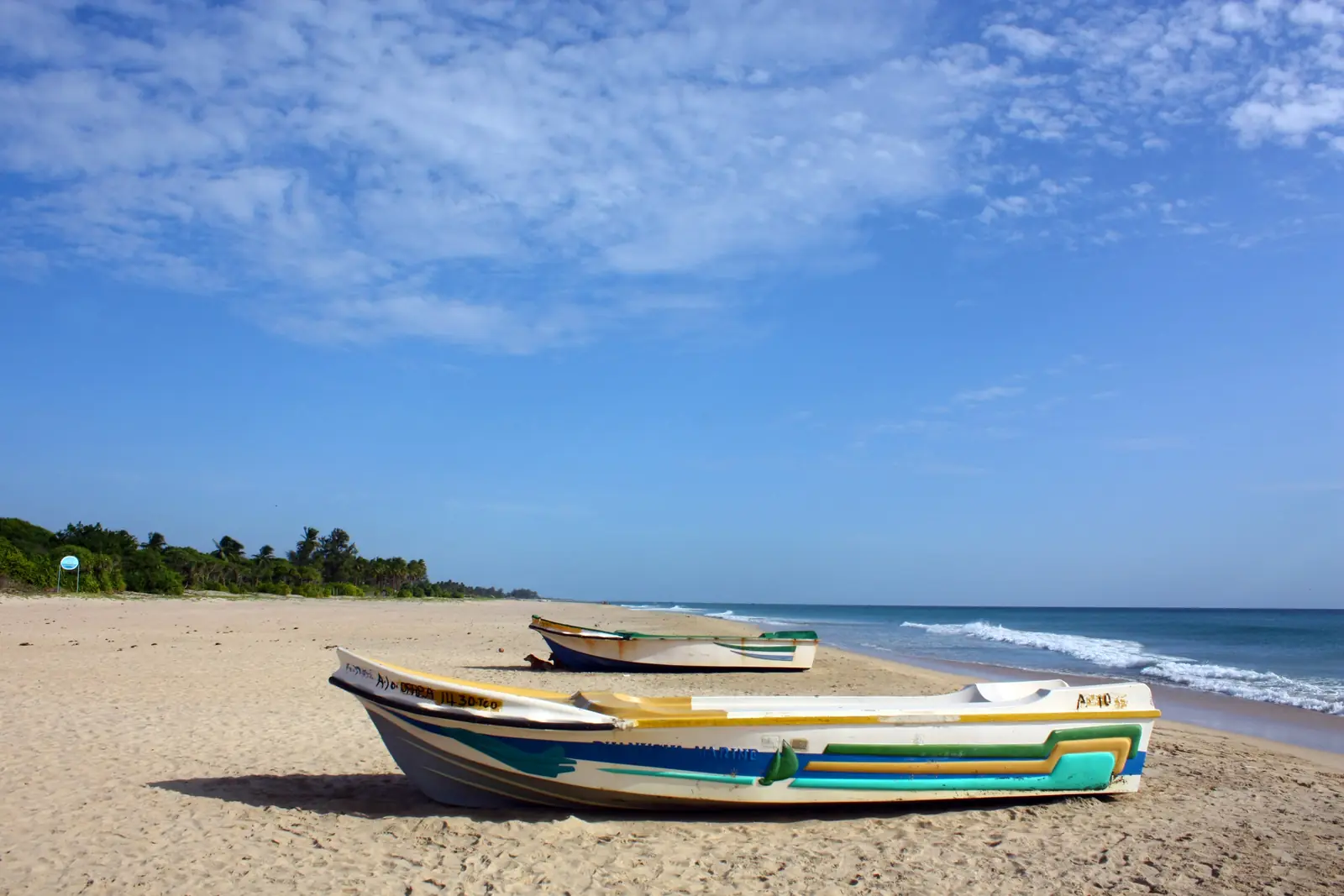
Most first trips to Sri Lanka run down the south and west coasts, and most of them are planned for December to March. That is sound advice for those months. It is also why so many people conclude that Sri Lanka has a rainy season, when what it really has is two coasts taking turns. From roughly May to September, while the south is being rained on, the east is dry, hot and calm - and considerably emptier than anywhere on the other side of the island.
Arugam Bay
Arugam Bay is the surf capital, and its season runs almost exactly opposite to the south's. Main Point, at the southern end of the bay, is a long right-hand point break that peels over sand and rock and draws surfers from across the world between May and September. It is not a beginner's wave, but the schools work the mellower inside sections of the bay and it is a perfectly good place to learn. Strung along the coast either side are the other breaks worth the tuk-tuk ride: Whiskey Point, Peanut Farm, Elephant Rock, and Pottuvil Point at dawn.
There is more here than surf. The lagoon behind the town is full of birds and the occasional crocodile, elephants cross the road near Lahugala in the evening, Kumana National Park an hour south is one of the best birding parks in the country with a decent chance of leopard, and the ruins of Muhudu Maha Viharaya sit quietly in the dunes. The town rebuilt itself after the 2004 tsunami and has stayed deliberately low-rise.
Trincomalee and the northern beaches
Trincomalee grew up around one of the finest deep natural harbours on earth, which is why every naval power that wanted the Indian Ocean wanted this bay. Fort Frederick still guards the entrance, built by the Portuguese in 1624 and handed on to the Dutch and the British, with spotted deer wandering its lane. At the end of that lane, Koneswaram stands on Swami Rock, a Hindu temple of real antiquity that the Portuguese pushed off the cliff in 1622 and which was rebuilt in the twentieth century - some of the original pillars were recovered by divers from the water below.
- ◆Uppuveli - the closest good beach to town, walkable to restaurants, an easy base.
- ◆Nilaveli - wider, quieter, and the departure point for Pigeon Island.
- ◆Marble Beach - south past the airfield, calm and shallow, good for families.
- ◆Pigeon Island National Park - living coral and blacktip reef sharks in water shallow enough to snorkel. Go early, take your own mask if you are fussy, and stay off the coral.
- ◆Kanniya hot springs - seven walled wells inland, more curiosity than spa, and worth an hour.
Pasikudah and Kalkudah
Pasikudah is the calmest swimming water on the island: a wide shallow bay where you can wade out a long way and never lose your footing, which makes it the obvious choice for families with small children. It is also the most developed stretch of the east, with a run of resorts along the bay. Kalkudah, immediately next door, is longer, emptier and rougher around the edges, and is where you go if the resort strip is not what you came for.
What to know before you go
- ◆It is a long way. Colombo to Arugam Bay or Trincomalee is the better part of a day by road. Build the east into a route rather than treating it as a side trip.
- ◆It is hot. Dry-season heat on the east coast is serious, and shade is scarce on the beaches. Plan around the middle of the day.
- ◆It is more conservative than the southern resort towns, particularly in the Muslim and Tamil towns along the coast. Cover up away from the beach - it costs you nothing and is noticed.
- ◆Infrastructure is thinner. ATMs are limited in Arugam Bay, so carry cash, and do not count on finding a pharmacy open late.
- ◆Out of season it closes. From November to March much of the east genuinely shuts, and Arugam Bay in January is a ghost town. That is not a hidden gem; it is just the wrong month.
If your dates fall in the middle of the year, the east is not a consolation prize for missing the south - it is the better half of the island at that moment. Browse the full east coast collection for everywhere worth stopping, or let the trip planner build a route that follows the weather rather than fighting it.