Off Sri Lanka's southern tip, the continental shelf drops away unusually close to shore. Deep water, rich feeding and a natural corridor around the island bring blue whales - the largest animals that have ever lived - within a couple of hours' boat ride of Mirissa harbour. Few places on earth make them so accessible. That accessibility is also the problem: on a busy morning a whale can surface to find a dozen boats racing towards it. Which boat you choose matters, for the whale and for your morning.
When to go
Boats run from Mirissa from roughly November to April, and December to March is usually the calmest and most productive stretch. From May to October the south-west monsoon makes the sea too rough and the trips stop. If you are in Sri Lanka in the middle of the year, whale watching moves to Trincomalee on the east coast, roughly March to August, though sightings there are less predictable. From November to April, Kalpitiya on the west coast is the place for spinner dolphins, sometimes in pods of hundreds.
What a trip is really like
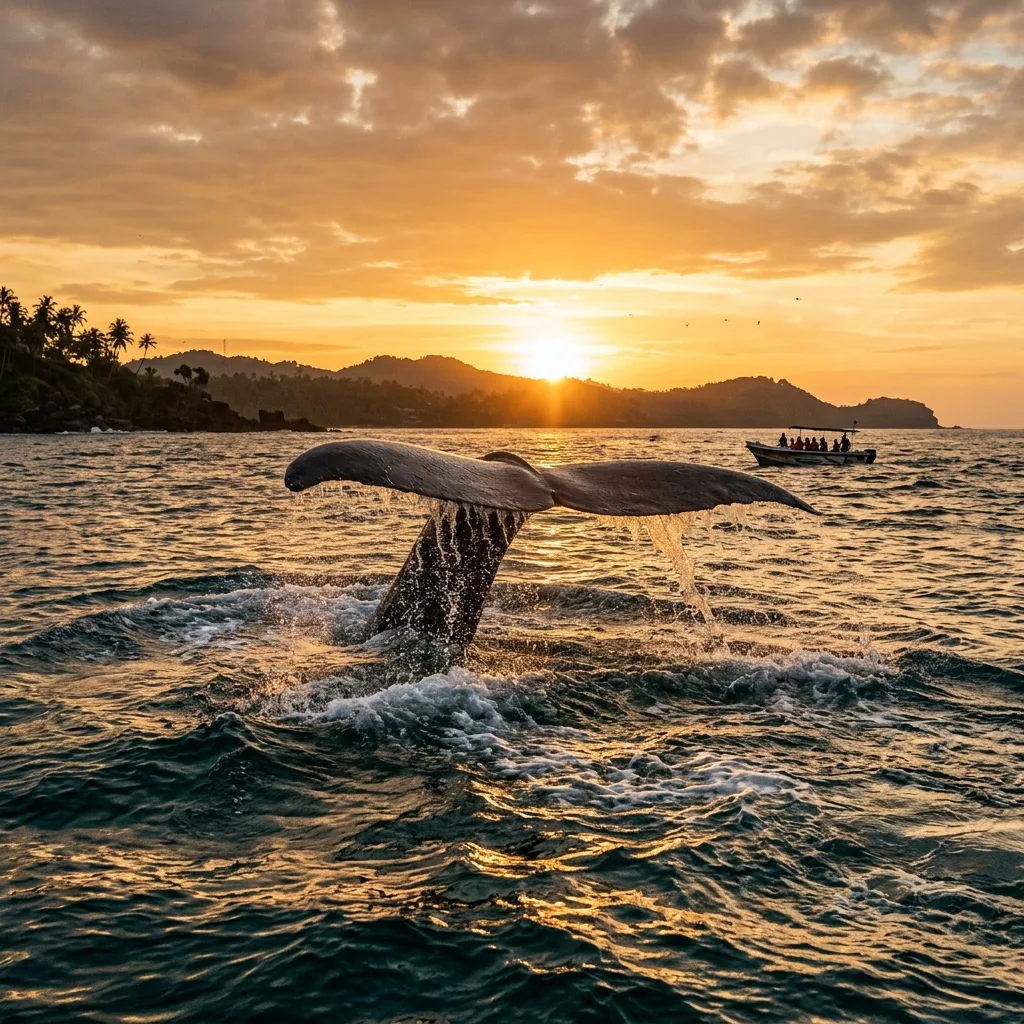
Boats leave Mirissa harbour early, usually around 6:30am, because the sea is calmest in the morning. Expect to be out for three to five hours, and longer if the whales are far offshore. The first hour is a run south over open swell to the edge of the shelf, where the crew scan for blows. When a whale is found the boat slows and waits; a blue whale typically breathes several times at the surface over a few minutes, then raises its tail and dives for ten minutes or more. Most of a whale-watching trip is spent looking at the sea, and the good ones still feel like a privilege.
Sightings are likely in season but never guaranteed. Prices vary with the boat, from around 10,000 rupees a person on a large shared vessel to $60 or more on smaller or more comfortable boats, usually including a light breakfast and water. Some operators offer a free second trip if you see no whales - ask before you book.
What you might see
- ◆Blue whales - the main event, and the large whale most often seen off the south coast.
- ◆Sperm whales - less common, sometimes in family groups, recognisable by the angled blow and wrinkled skin.
- ◆Bryde's whales and fin whales - occasional visitors.
- ◆Spinner dolphins - often in large, acrobatic pods, frequently met on the way out.
- ◆Flying fish and turtles, and on rare, lucky days orcas or false killer whales.
Choosing a responsible operator
Every commercial whale-watching boat should hold a licence from the Department of Wildlife Conservation, and there are rules on how close boats may approach and how they must behave around whales. Enforcement is patchy, and some crews chase, cut across a whale's path or crowd it with other boats to get their passengers a closer look. That stresses the animals and can drive them away from feeding grounds. You can't control the whole fleet, but you can choose who you pay.
- ◆Ask how they approach. A good answer involves slowing well before the whale, approaching from the side or behind rather than head-on, and never boxing it in.
- ◆Read recent reviews for chasing. Traveller reports of boats speeding at whales are a reliable warning sign.
- ◆Prefer a naturalist on board. Operators that carry a guide who explains what you are seeing tend to take the animals' welfare more seriously.
- ◆Don't pay extra for 'closer'. An operator promising to get you right next to a whale is telling you how it behaves around them.
Avoiding seasickness
The swell off the south coast can be big even on a sunny morning, and seasickness ruins more whale-watching trips than a lack of whales. If you are at all prone to it, take a tablet the night before and again before you board, eat a light breakfast, and sit low and towards the back of the boat, where the motion is gentlest. Keep your eyes on the horizon rather than your phone. Large boats roll less than small ones.
Photography
Responsible boats keep their distance, so reach matters more than an expensive camera body: something in the 100 to 400mm range, or the telephoto lens on a phone. Use a fast shutter speed for the tail fluke as the whale dives, and wear a strap - the spray is constant and the rail is low. Mostly, though, put the camera down for at least one surfacing. The sound of a blue whale's breath carrying across the water is the part no photograph keeps.
Making a trip of it
Plan two or three nights on the south coast so that one rough morning doesn't cost you the trip - boats are cancelled when the sea is unsafe, and a spare morning lets you go again. Mirissa has a good crescent beach and the much-photographed Coconut Tree Hill; Weligama next door is the gentler place to learn to surf; Galle Fort is under an hour away; and Dondra Head, the island's southern tip, is just to the east. Our month-by-month guide shows what else is in season while you are there.