Adam's Peak - Sri Pada to Sri Lankans - is a 2,243-metre cone of rock rising from the forest at the southern edge of the hill country, and one of the few mountains on earth climbed by followers of four religions. On its summit is a footprint-shaped hollow in the rock: Buddhists revere it as the footprint of the Buddha, Hindus as that of Shiva, and many Muslims and Christians as the place where Adam first set foot on earth. For half the year, pilgrims climb through the night to reach the top for sunrise. Joining them is one of the most memorable things you can do in Sri Lanka.
The season
The pilgrimage season runs from Unduvap Poya, the December full moon, to Vesak in May; for 2026-27 it opens on 23 December 2026. During the season the path is lit all night, tea shops and stalls along the way are open, and the summit temple is active. Outside it, the lights are off, the shops are shut, the weather on the mountain is often wet and windy, and leeches come out on the lower path. The climb is still possible then, but only in good weather, ideally with a local guide, and without expecting a view.
Within the season, January to March usually gives the best mix of clear skies and manageable crowds. Late December, just after the season opens, and April, with afternoon storms building, are less reliable.
The routes
- ◆Hatton - Nallathanni. The route almost everyone takes, and the shortest: around 5,500 steps and about 1,000 metres of climbing from the village of Nallathanni, also called Dalhousie, some 32 kilometres from Hatton. Most people take three to four hours to climb and two to three to come down.
- ◆Ratnapura - Palabaddala. The traditional pilgrim route from the south-west: much longer, steep in places and far quieter, typically six to eight hours up. For experienced hikers who would like the mountain to themselves.
- ◆Kuruwita - Erathna. Another long route from the Ratnapura side, through forest, rarely used by visitors and best done with a guide.
The night climb from Nallathanni
Most climbers set off between 2am and 3am to reach the summit for sunrise, which comes at around 6 to 6:30am during the season. The path starts gently, past the Japanese peace pagoda, then becomes a seemingly endless staircase that steepens as it climbs, with the last stretch close to vertical in places and a handrail to hold. Tea shops every few hundred metres sell sweet tea, biscuits and noodles, and they make natural rest stops.
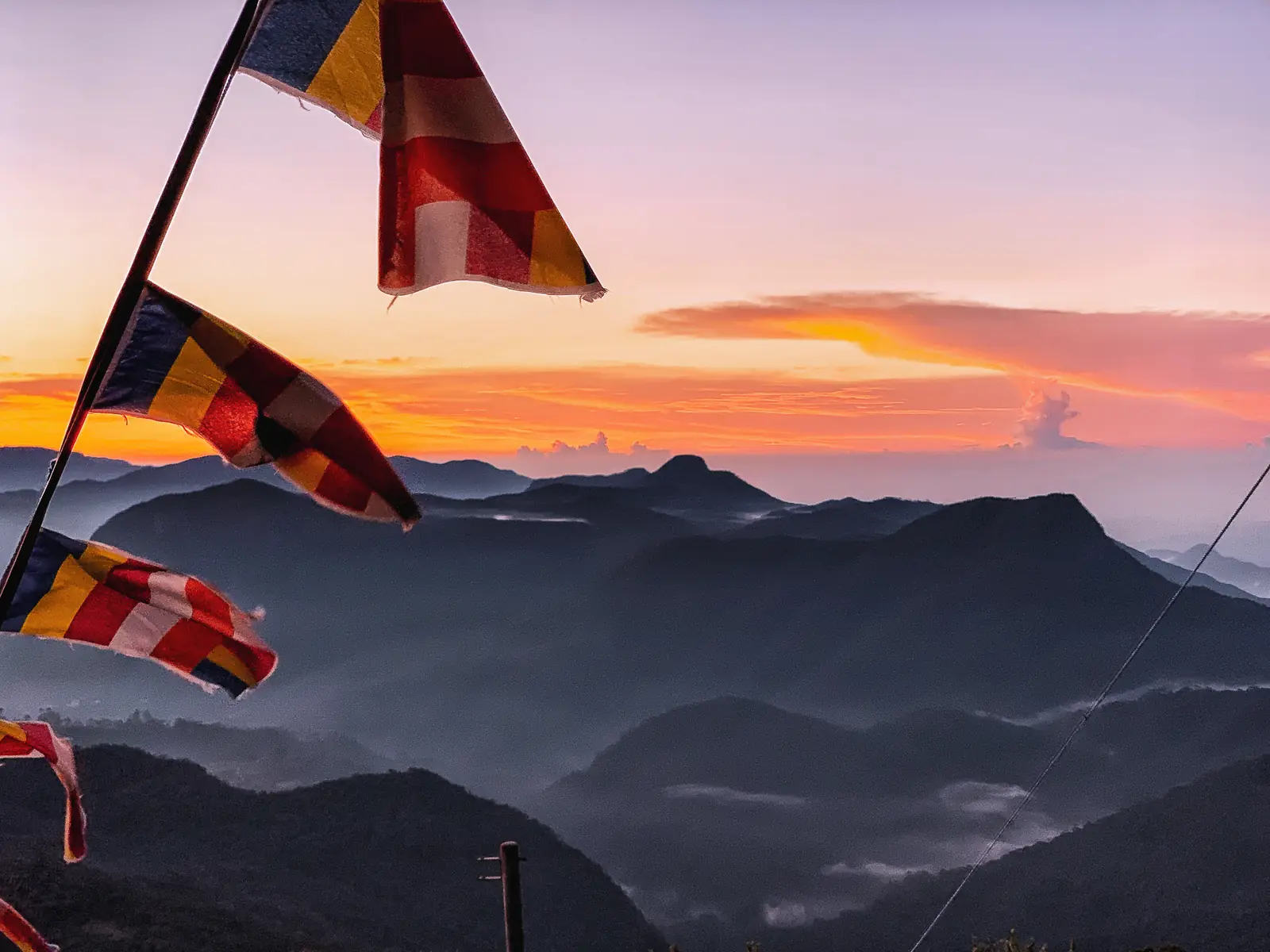
The summit platform is small and fills fast. Find a spot facing east, put on every layer you carried, and wait. As the sun comes up, the mountain casts a near-perfect triangular shadow across the land and cloud to the west - the famous shadow of the peak, which lasts only a few minutes. Pilgrims ring the summit bell, one ring for each climb they have made.
Crowds
On weekends, public holidays and above all Poya days in the season, thousands of pilgrims may climb on the same night, and the final stretch below the summit can turn into a queue that barely moves for hours. Climb on a weekday if you possibly can, and check the Poya calendar. The atmosphere on a busy night is extraordinary - elderly pilgrims climbing barefoot, families chanting together, strangers helping each other up the steps - but you may not make the top by sunrise.
What to bring
- ◆Warm layers and a windproof jacket for the summit.
- ◆A head torch, in case the lights fail on a section of the path.
- ◆Water and snacks, though both are sold along the way.
- ◆Cash in small notes for tea and food.
- ◆Shoes with good grip. The steps are uneven and can be wet.
- ◆A dry T-shirt to change into at the top, so you aren't sitting in a sweat-soaked one.
Respect on the mountain
This is a pilgrimage first and a hike second. Dress modestly, especially at the summit temple, where shoes and hats come off. Let elderly pilgrims pass, don't push in the queues, and keep music to yourself. Our temple etiquette guide covers the customs in more detail.
Getting there and where to stay
Nallathanni is about an hour by road from Hatton, which is itself about three hours by road from Kandy. Hatton is a stop on the hill-country railway, but the section between Kandy and Nanu Oya is still under repair after the 2025 cyclone, so check our train guide before planning to arrive by rail. Stay the night before in one of Nallathanni's guesthouses, so you can sleep for a few hours and walk out of the door at 2am. Afterwards, the tea country around Castlereagh Reservoir and Bogawantalawa is a beautiful place to recover, and Horton Plains is within reach.
How hard is it?
It is a long, relentless staircase rather than a technical climb, and the descent is harder on the body than the ascent - your thighs will remind you of it for two or three days. Anyone in reasonable health can do it at their own pace, and plenty of pilgrims in their seventies do. Start slowly, rest at the tea shops, and don't treat turning back as failure: on a mountain this sacred, the pilgrims will tell you the climb itself is the point.
Adam's Peak fits naturally into the hill-country leg of a trip. Our itineraries show where, and the December section of our month-by-month guide explains the season.